Maps & Workshop
Zombies Aren't Real Maps & Workshop
The city you defend in Zombies Aren't Real is a real place. Here is where that geography comes from, what the official editor can do with it, and what the community has already built on top.
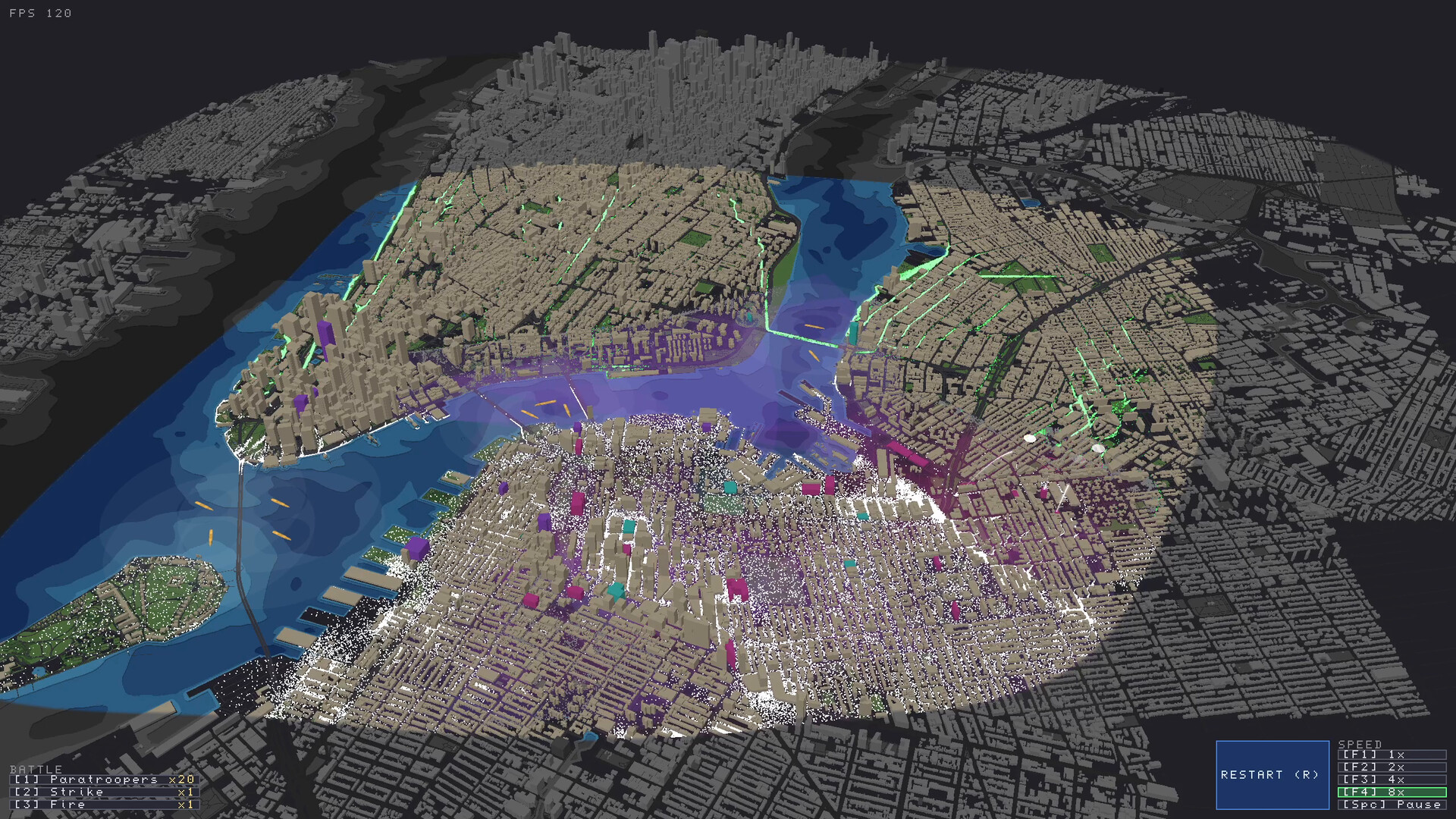
The maps are real places
Zombies Aren't Real does not generate fictional cities. It builds them from public geo data, so the streets you wall off, the parks you avoid enclosing and the bridges you have to hold are the real ones.
The store page credits the sources the game draws from: OpenStreetMap contributors, the Overture Maps Foundation, TomTom, Microsoft, Esri Community Maps contributors, Google Open Buildings, work derived from BTN 2024 (ign.es, CC BY 4.0), and postal codes from GeoNames (CC BY 4.0). That list is the reason a map can look like an actual city with an actual harbour rather than a grid of blocks.
It also changes how you plan. Real street layouts produce real problems: a perimeter that crosses a park covers a lot of ground cheaply and defends badly; a waterfront district is bounded by water on three sides; a canal city splits into islands that a wall has to connect. Nothing about a map is abstract, which is exactly why the same garrison setup that works in one district can fall apart two streets over.
The level editor
The game includes a level editor, and the store page is specific about what it supports: you can pull in map data from many zip codes across the world and build scenarios from them, and the game uses public geo data to do it. In other words, the editor is not a decorative extra - it is the same mechanism the shipped missions are built on, pointed at a place you choose.
Practically, that means the question "can I defend my own city?" is answerable in-game, not just in the Workshop.
What the Steam Workshop has
The Zombies Aren't Real Steam Workshop holds player-made maps and gameplay mods. The Workshop has been active since launch week, and the popular items at the time of writing are:
City maps (campaign scenarios):
| Map | Creator |
|---|---|
| London, England | drizzlehalo |
| Tokyo, Japan | Devin |
| Moscow, Russia | Ambulans |
| Berlin, Germany | Devin |
| Stockholm, Stockholm County | General |
| Auckland | Jo |
| Sydney, New South Wales | Durnaviir |
| Istanbul, Turkey (Europe/Asia) | Ambulans |
| Dubai, Dubai Emirate | Wolf lad |
| Cairo, Egypt | Ambulans |
| Dublin, Ireland | Drep |
| Montreal, Quebec | Platycephalidae |
| Jacksonville, FL | Cumin |
| Manchester M60, England | VY Canis Majoris |
Gameplay mods:
- Weak Bridges (Rage)
- Slower Zombies IMPROVED (felipeaita)
- Elite Paratroopers (XROCK)
- More money and skill points at start (Twinky)
- No Safe Zone Limit (ItchyBalls2017)
- Project zomboid (XROCK)
The mod names tell you where the community's difficulty dial sits. Slower Zombies IMPROVED and No Safe Zone Limit are both levers on the two things that make a run hard: how fast the horde moves, and how much ground you are allowed to wall off. More money and skill points at start moves the budget constraint instead. If you find the shipped scenarios either too tight or too loose, that is the list to work through.
Picking a Workshop map
Three things decide whether a community map is worth your evening:
- Is it a campaign scenario or a mod? The Workshop labels them. Campaign scenarios are missions; mods change rules and apply on top of whatever you are playing.
- How big is the city? A small city map and a full harbour map are different games. The zoomed-out screenshots show how much of a city a single mission can cover, and the Workshop ranges from single districts to whole metropolitan areas.
- What does the creator say about the target? Survival requirements differ between scenarios, so a map that asks for 10% civilians safe plays very differently from one that asks for a small fraction of that.
One caution for Early Access
The game is in Early Access, and the store page states that the content is incomplete and may change. That applies to the editor and the Workshop flow too: the store page already mentions support for uploading and playing custom maps, and SteamDB lists a separate Zombies Aren't Real Playtest build alongside the main game. If a specific editor feature or Workshop item behaves differently after an update, the developer's patch notes and the Workshop page for that item are the place to check before assuming the map is broken.