Units & defense
Zombies Aren't Real Units & Defense
The store page lists the arsenal. The game's own UI prices it. Here is what each piece of the Zombies Aren't Real toolkit is for, and where it earns its cost.
Two lists, not one
Zombies Aren't Real splits its tools into two groups, and mixing them up is the fastest way to waste a budget.
Deploy units are placed during the planning phase and stay for the whole battle: garrisons, mortars, snipers, spikes, turrets, mine fields and C4. They cost money up front and their positions are your plan.
Battle abilities are carried into the fight through your loadout and used while the battle runs: paratroopers, strikes, missiles, gas, helicopter support and APCs. They are the answer you keep in your pocket for the moment the plan stops holding.
The deploy menu, with prices
The planning screen prices each option, and the figures below come from one early city scenario (the same screen that shows a $9,410 budget and a $1.00-per-cell safe zone). Treat them as relative costs rather than a fixed price list - scenarios differ, and Early Access updates can move numbers.
| Deploy option | Price shown | What it is for |
|---|---|---|
| Sniper | $38 | The cheapest unit on the list. Long-range fire for an approach nothing else covers. |
| Turret | $90 | Concentrated fire on one wall section or one exposed street. |
| Garrison | $150 | Soldiers placed inside a building that can fire toward your safe zone boundary. |
| Mine Field | $200 | Area denial on the ground a horde will walk over. |
| Mortar | $270 | Area damage against groups, from range 160-630 m in the panel shown, with a 40 m blast. |
| Spike | $1.00 | Per-unit pricing, so it scales with how much you place. |
| C4 | $500 | The most expensive option on the list - a placed, targeted charge. |
Three things in that table are worth internalising.
Cheap does not mean weak. The sniper is a fraction of the garrison's price, and the game's own stats panel records snipers out-killing garrisons in real runs. Price tracks role and reach, not importance.
Buildings fight too. Safe zones are priced per cell, and the walls, gates and fortify options sit in the build menu rather than the deploy menu. The selected-unit panel in the screenshots shows a mortar emplacement with building health 1000/1000 - your fortifications take damage and can be destroyed, which is why a wall with no defenders behind it falls.
Units upgrade. The mortar panel shows "Lv2: 3x Fire Rate, Reload" and a Level Up $150 button next to SP Upgrades and Refund (X). Money you did not spend on deployment is not dead money; it buys levels, and the refund key lets you move a bad placement instead of restarting.
What the stats panel tells you
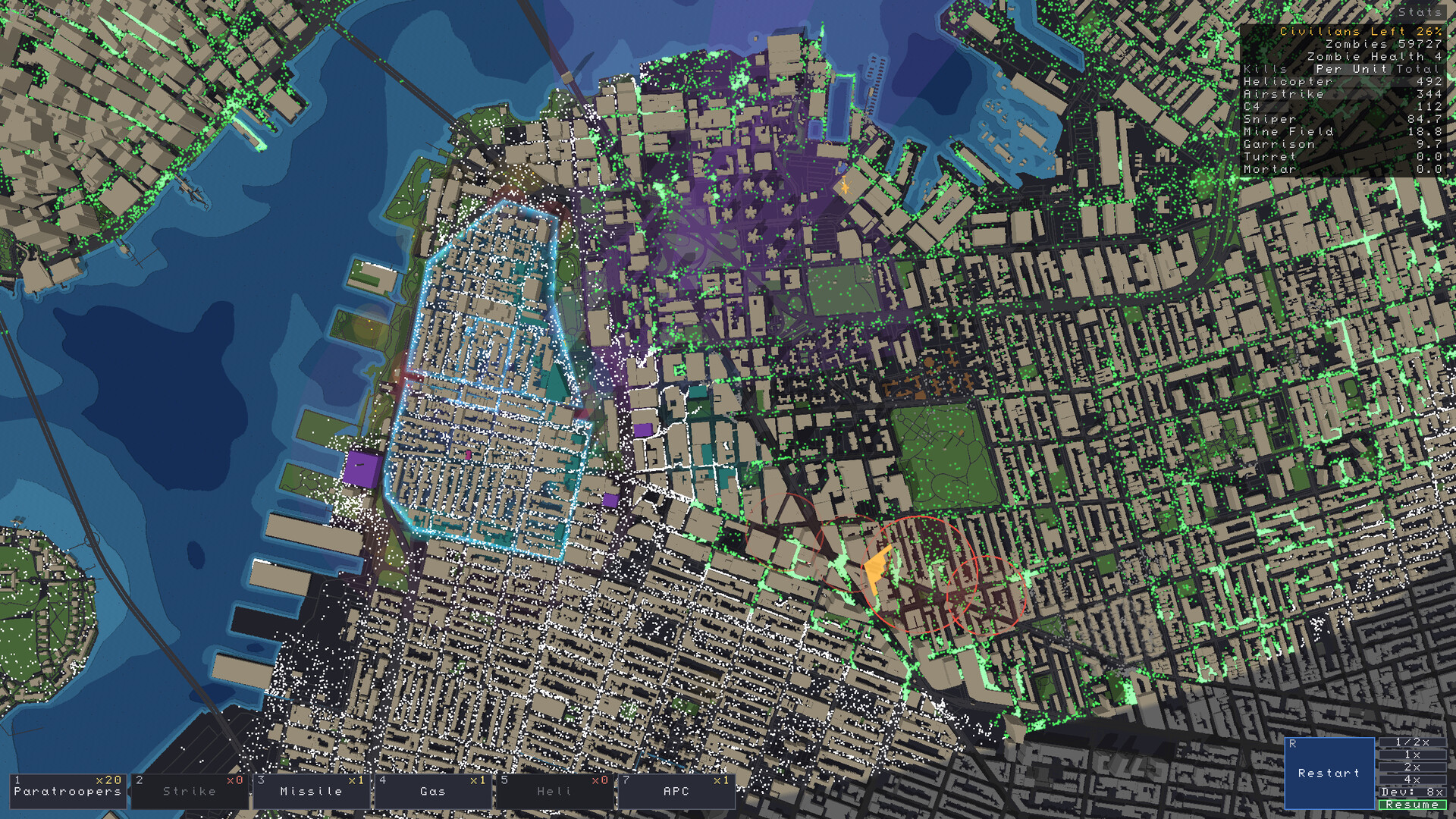
The battle screen tracks kills per unit type, per unit and in total. Across the official screenshots that panel lists: Helicopter, Airstrike, C4, Sniper, Mine Field, Garrison, Turret and Mortar.
Read it after a run, not during it. It answers the question your plan was silently asking: where did the kills actually come from? A run where mortars and turrets sit at zero and helicopters carry the game is a run whose ground plan did not hold. A run where garrisons and snipers do the work and air support stays unused is a plan that held - and one where the next, harder scenario probably needs a different answer.
The battle abilities
The bottom bar in the battle screenshots carries the loadout you brought: Paratroopers, Strike, Missile, Gas, Heli and APC appear across them, with counts next to each (20 paratroopers, 1 missile, 1 gas, 1 APC in one shot; 20 paratroopers, 1 strike, 1 fire in another). The counts differ because the loadout differs per scenario and per unlock - which is the point of the loadout screen.
What each ability is for, in plain terms:
- Paratroopers come in a large count and are the volume answer: boots on the ground where the wall is about to fail.
- Strike and Missile are targeted firepower on a spot you pick. Aim them; the blast does not check who is standing there.
- Gas is area control over a street or cluster.
- Heli is helicopter support - the gatling gun helicopter the store page names - and the stats panel shows it out-killing everything else in a heavy run.
- APC is a vehicle you bring in when you need presence on a street rather than one shot at a point.
The store page adds the air-support framing that ties this together: you can call in bombers or gatling gun helicopters when the perimeter breaks, but you have to aim them well to minimise civilian casualties. Your score is the number of civilians you saved, so an airstrike that clears a block and kills the people it was protecting can cost you the run.
Where each unit earns its price
- Garrisons earn their cost when the building they occupy can actually see the wall section that will be attacked. Buildings block their own line of fire; a garrison behind a tall block is a garrison that watches.
- Snipers earn their cost on long, open approaches and on positions where a cheaper unit cannot reach.
- Turrets earn their cost on one specific wall section you already know is weak - not spread evenly across a perimeter you have not tested.
- Mortars earn their cost against groups, from rooftops and other elevated positions the game highlights. Slow fire rate and a 40 m blast mean they punish clustering, and they punish you when civilians are in the blast.
- Mine fields earn their cost on ground the horde must cross.
- C4 earns its cost when you need one thing to stop existing and nothing else will do it.
If you are deciding what to buy first on a new map, the cheapest honest answer is: read the streets. A plan built around where the zombies will walk beats a plan built around what looked strongest on the menu.